
Curriculum5 min read
The Complete Guide to the Primary Music Curriculum (UK)
Music is more than just an extra subject on the timetable. It develops listening skills, creativity, coordination, and confidence, while also giving...
Music is more than just an extra subject on the timetable. It develops listening skills, creativity, coordination, and confidence, while also giving children a shared cultural experience. The UK national curriculum for music ensures every child has the chance to enjoy high-quality music education, but delivering it consistently in primary schools can feel daunting—especially when most teachers aren’t music specialists.
This guide unpacks what the curriculum requires, how progression works, and how schools can make music accessible for every teacher and every pupil.
What the Curriculum Actually Says
At Key Stage 1 (Years 1–2), children should:
- Sing and use their voices expressively.
- Play tuned and untuned instruments.
- Listen carefully to music from different traditions.
- Explore and experiment with sound.
At Key Stage 2 (Years 3–6), pupils should:
- Sing and play with accuracy and control.
- Improvise and compose music for different purposes.
- Use and understand notation.
- Appreciate a wide range of musical traditions and history.
The expectation is that children progress gradually from simple participation in EYFS, through rhythm and melody in KS1, towards more confident performance, composition, and understanding by the end of KS2.
The Role of the Model Music Curriculum
In 2021, the Department for Education introduced the Model Music Curriculum (MMC). It’s not compulsory, but it offers more detailed guidance on repertoire, year-by-year progression, and outcomes. Inspectors often look for schools to have engaged with it.
The MMC encourages:
- A varied musical diet (classical, jazz, folk, pop, world music).
- Structured development in singing, listening, composing, and performing.
- Clear expectations for each year group.
Schools can use it as a reference point when shaping their own curriculum, ensuring consistency and breadth.
Planning a Whole-School Approach
A strong primary music curriculum usually has three essentials:
- Coverage – every year group has planned opportunities for singing, listening, performing, and composing.
- Progression – skills build logically from year to year.
- Flexibility – activities adapt for mixed-age classes and children with additional needs.
A sample pathway might look like this:
- EYFS – sound exploration, movement, call-and-response songs.
- KS1 – rhythm patterns, body percussion, simple instruments, singing games.
- Lower KS2 – graphic notation, short compositions, learning about genres.
- Upper KS2 – ensemble work, staff notation, improvisation, more complex listening tasks.
How Schools Can Show Progression
Because music isn’t assessed with written tests, leaders often worry about proving coverage. The key is to focus on:
- Skills-based statements (“can keep a steady pulse”, “can sing a two-part round”).
- Short audio or video clips as evidence.
- Teacher notes that show what children can do now, and what comes next.
This approach provides rich evidence for SLT and inspectors without unnecessary paperwork.
The Challenge for Teachers
Most primary teachers are not music specialists. Common barriers include:
- Lack of confidence in teaching singing or notation.
- Limited planning time.
- Difficulty adapting lessons for mixed-ability or mixed-age classes.
That’s why resources designed for non-specialists are so important. They provide structure, clarity, and reassurance, so teachers can focus on leading enjoyable lessons rather than worrying about their own musical expertise.
How Digital Tools Like Kidstrument Help
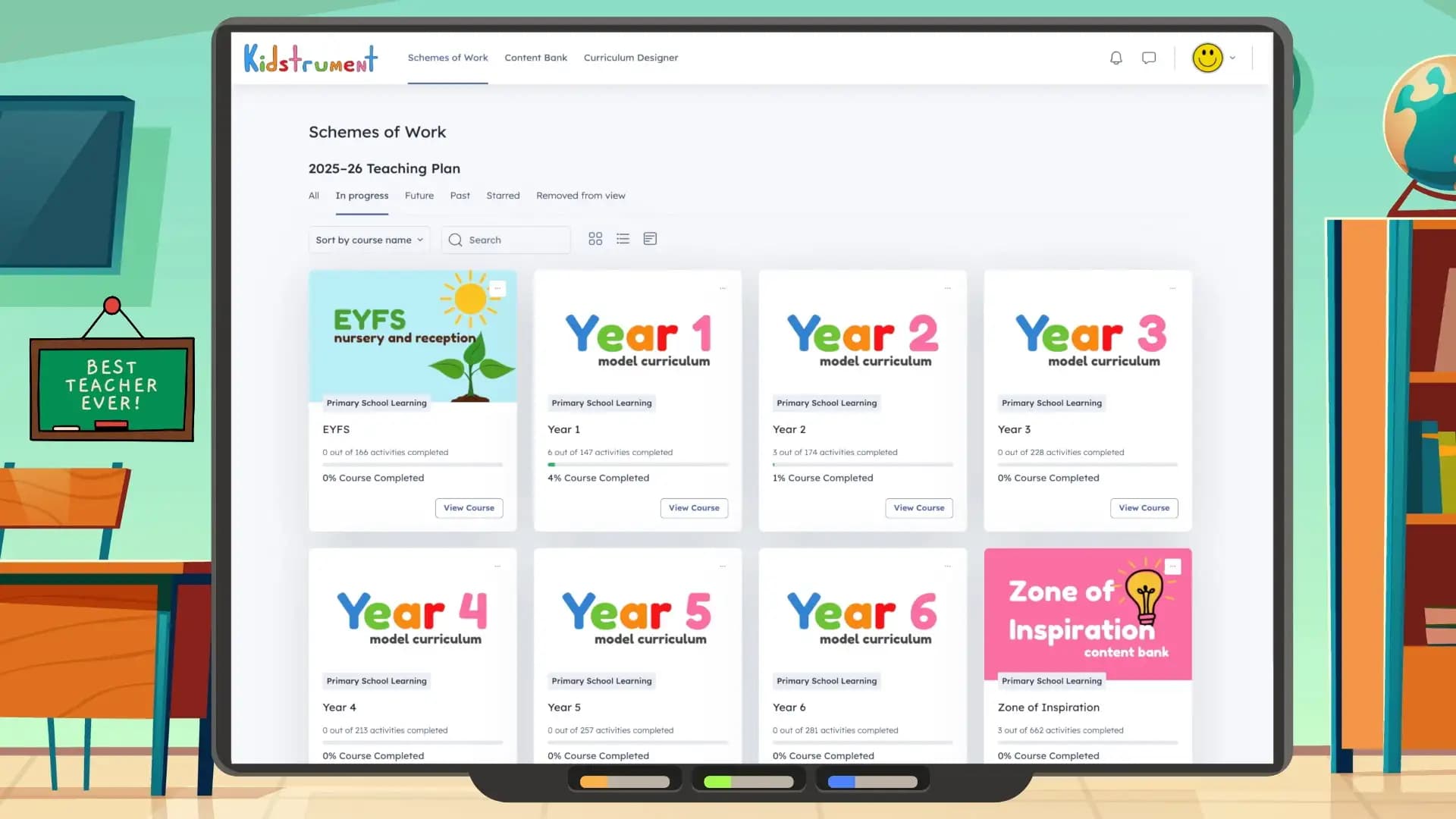
Kidstrument was created to make music accessible for every teacher, not just musicians. It offers:
- Over 1100+ ready-to-teach activities mapped to the curriculum and MMC.
- A curriculum builder that lets leaders design pathways and ensure coverage.
- Tools for tracking progression and outcomes across EYFS to Year 6.
- Flexible resources that work with mixed-age groups and SEND learners.
This saves teachers hours of planning while giving leaders confidence that music provision is secure.
Music in primary schools doesn’t need to be complicated. With the right framework and resources, schools can give every child the chance to sing, listen, create, and perform—building skills that will last a lifetime.
Want to simplify music teaching in your school?
Try Kidstrument free
Related: For scheme selection, see what subject leaders should look for in a primary music scheme of work.
How to turn the curriculum into lessons
The statutory curriculum sets the expectation, but schools still need a teachable route. That route should show when pupils sing, listen, play, compose, improvise, perform and use notation. The National Curriculum music programmes of study is the starting point for maintained schools, while the DfE teaching music guidance can help with sequencing.
Kidstrument's curriculum map, schemes of work and Content Bank connect those expectations to practical lessons. To see the route in action, try Kidstrument free.
FAQ
What should a primary music curriculum include?
It should include singing, listening, performing, composing, improvising, notation and musical vocabulary across the school.
Does every school need the same route?
No. Schools can adapt routes, but progression and regular practical music should remain clear.
How subject leaders can check coverage
Coverage checks should be simple. Can every year group show when pupils sing, listen, perform, compose and meet notation? Are pupils revisiting pulse, rhythm, pitch, tempo, dynamics, timbre, texture and structure? Are teachers using resources that match the planned sequence?
A subject leader does not need to collect evidence from every lesson. A coverage report, a few examples of pupil work, short recordings and staff feedback can show whether the curriculum is happening. The next step is then to support gaps, not create more paperwork.
How to avoid a paper curriculum
A curriculum document is only useful if it changes lessons. Each unit should lead to practical classroom activity: singing, moving, playing, listening, composing or performing. If a section of the map is hard for teachers to teach, it needs clearer resources or a simpler route.